MUTUAL AID/Monaco, it’s not only the jetset, the racing cars and the big yachts. Monegasques are mobilizing for humanitarian actions. Focus on some of them.

Families and children: the most fragile migrants
CHILDHOOD/Since early September, the Italian Red Cross camp in Ventimiglia has been receiving families, single women with children and unaccompanied minors. Their highly precarious situation requires very special care.
Restrained little laughs emerge beneath the high canvas sheltering the canteen of the Italian Red Cross camp in Ventimiglia. Located on the outskirts of the city, the place – known as Roya Camp or Camp la Roya – is surrounded by roads and road bridges perched on viaducts. Concrete is the master of the weather here – always grey. Yet, 15 days before Christmas when L’Observateur de Monaco visits it, the children’s smiles always have the power to arouse lightness. Amir, Arbaz and their big sister Farishta, three little Afghan children – brothers and a sister aged 7 to 11 – are very busy. All afternoon they have been making Christmas decorations with an Italian Red Cross facilitator. They are now writing their first names in coloured letters on checked A4 sheets.
Grateful
Farishta speaks English and has written her story, in a child’s simple words. “I am truly grateful to my god because our journey is over.” The 11 year old girl says they arrived in Ventimiglia two days ago. She does not remember too well where she went before that. She thanks the associations for their hospitality, the Red Cross and also Caritas, which hands out clothes and hot meals in the city centre every morning. Like many families ending their journey here, without doubt she transited through Libya. There she must have witnessed abuse of migrants – if she did not suffer it herself. Imprisonment, torture, sale of slaves, rape. But that afternoon, the smiles are back again and the children are happy.
Well-being
Behind them, two other little girls aged 2 and 3 are cutting and sticking pretty Christmas pictures. Soon the toddlers will decorate a Christmas tree together. Meanwhile, their mothers look after them a little. In a separate room in the large Algeco container that is the camp reception, six women aged 18 to 30 take part in a “care” workshop with Renate, an Italian Red Cross volunteer. “Every week I’m here to do my face or nails,” Happy explains in English. The young woman uses a face cloth to remove her face mask. On her back, a peaceful infant is suspended by a large cloth.

Practical issues
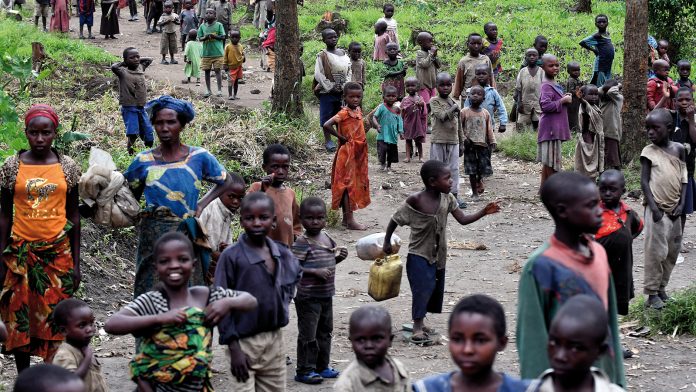
Next to her, the other women enjoy this time as a well-being break in their week at Roya camp. “Through care, I address practical issues like sanitary towels, how to buy them etc. Some have never seen one before,” says Renate. Hygiene and well-being are in fact big issues for these young women from Nigeria, Eritrea or Sudan. Princess Caroline of Hanover travelled to the Democratic Republic of Congo from 24-28 September. Among her visits, she presided over the opening of the country’s first sanitary protection factory in Gbadolite, through the Amade-Mondiale association set up by Princess Grace in 1963. This project, named “Dignity for women”, allows Congolese women to benefit from chemical-free sanitary towels made in their country. The factory has hired around 100 women.
Teenagers’dreams
Protecting women and their children is at the core of Amade Mondiale’s mandate. While it reaches to Africa, it is also obvious for the non-profit association to act nearby. Thus, the Italian association Terre des Hommes, specialised in protecting and informing minors, receives funding from Amade-Mondiale. “There are many unaccompanied minors”, stresses Jérôme Froissart of Amade-Mondiale. “They may have lost their mother during the crossing, for example. Or they are teenagers fleeing their country for political and economic reasons. They come to try their luck.”
Sending money
The lack of prospects in their home country, where hunger prevails, pushes families to raise large sums to pay smugglers to take these teenagers to Europe. “They are very young, usually 13 to 16,” says Elena Prestt, Terre des Hommes coordinator in Ventimiglia. “They come from Eritrea, Somalia, Sudan, Darfur. A great many come from Ivory Coast.” They took the same route here, through Libya. But they all have the same dream. “The reason is mainly economic,” clarifies Claude Fabbretti of the Monegasque Red Cross international humanitarian section, explaining that these young people are seeking a better life. “They are pressurised by their family, which has invested in the journey and created real hope in them.” Because they will have to send the family money to improve its daily life.
Fear of the police
But before they can do so, they have to face awful situations. “Some of these young people are used as mules by drug networks operating in their transit areas, and there are also paedophile networks that exploit young people,” the Monegasque Red Cross member describes again. “This human trafficking does not take place only in Libya, it is also found in African countries.” In the end, they have often gone through hell when they arrive in Europe. “They are very afraid and weakened by their journey. They are afraid of the police, of being put on file. They have a huge need for information.” emphasises Elena Prestt. In many cases these teenagers do not know their rights. And the information circulating among them, mainly conveyed by smugglers in Italy hoping to pick up a few hundred euro, does not reassure them.

Psychological support
So the volunteers of the various associations active in Ventimiglia need to go and meet these young people, undo the false information and give new information. “When they arrive in Italy, usually through one of the three hotspots, Terre des Hommes offers them psychological support”, Elena Prestt adds. A lawyer and a psychologist come regularly to the Red Cross camp in Ventimiglia to inform and listen to families, single mothers and children. 58 families and 27 unaccompanied minors occupy specially dedicated containers. There are two of them, their doors are opposite one another and barriers demarcate the area. At the centre of the two containers divided into rooms, a gazebo supports drying clothes. Here, a small community has formed since September. Previously, families and children were taken care of in St. Anthony’s church in the centre of Ventimiglia. But a prefectural decree closed it to them. From now on, Roya Camp receives all migrants, regardless of their nationality and gender.
Place dedicated to children
“The children’s presence has transformed the camp atmosphere, even for the adults, seeing them play brings a little joy,” says Elena Prestt. The volunteers try to speed up the procedures for them, but also to give them more comfort. In late December, two new containers arrived at the camp thanks to Amade-Mondiale. “They are put together and they form an area reserved for the children, to try to organise activities,” explains Jérôme Froissart. In this privileged place, the facilitators and volunteers will be able to busy the children with games, but also explain the situation to them. As everyone hopes that their transit through this camp can only be temporary.
_Sophie Noachovitch

