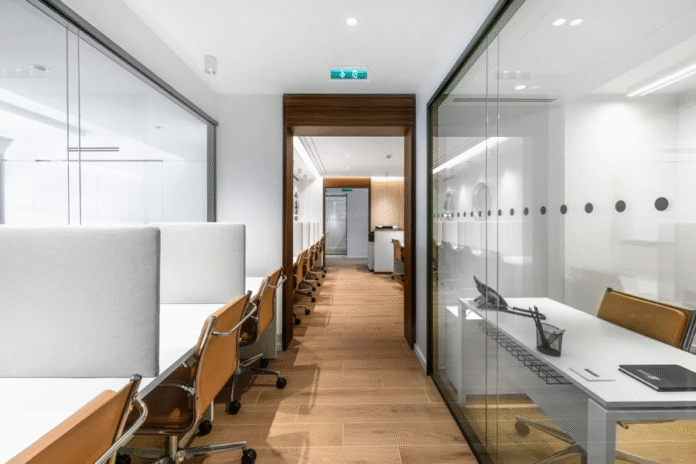
Now numbering 34, business centers have become fully fledged players in Monaco’s economic development. What explains their success? What pricing strategies do they use? Who are their clients? And although the market clearly answers a genuine need, is it reaching its limits? We take a closer look.
Having an office in Monaco conveys a premium, prestigious brand image — a symbol of success and exclusivity for any company. But the office supply is limited, and rents are prohibitive for many businesses. This challenge is precisely what underpins the success of Monaco’s business centers. For €990 per month before tax, a limited liability company (SARL) less than three years old with no employees can access an open-plan workspace in one of the Principality’s centers. A sole proprietorship can even stay six months (three months renewable once) in open space for €450 per month before tax, and Monégasque nationals benefit from a 12-month rate at €300 per month before tax.
Standardized rates for open-plan workspaces
These rates were proposed — though not formally imposed — by the government. However, business centers, united under the Monaco Chamber of Business Centers (CPMCA), have signed an ethics charter committing them to comply. “There’s a gentleman’s agreement between us to keep things coherent. The idea is to avoid a needless and counterproductive price war — both for business centers and for the country’s image. Monaco needs companies that pay a fair, justified price to operate in the Principality,” explains Yann Bertrand, co-founder of Monte-Carlo Business Center (MCBC), which now operates three locations. “In reality, not everyone plays by the rules,” one source confided. A slight price adjustment has been agreed for 2025, as rates had not been updated for inflation in several years.
Private offices : free pricing
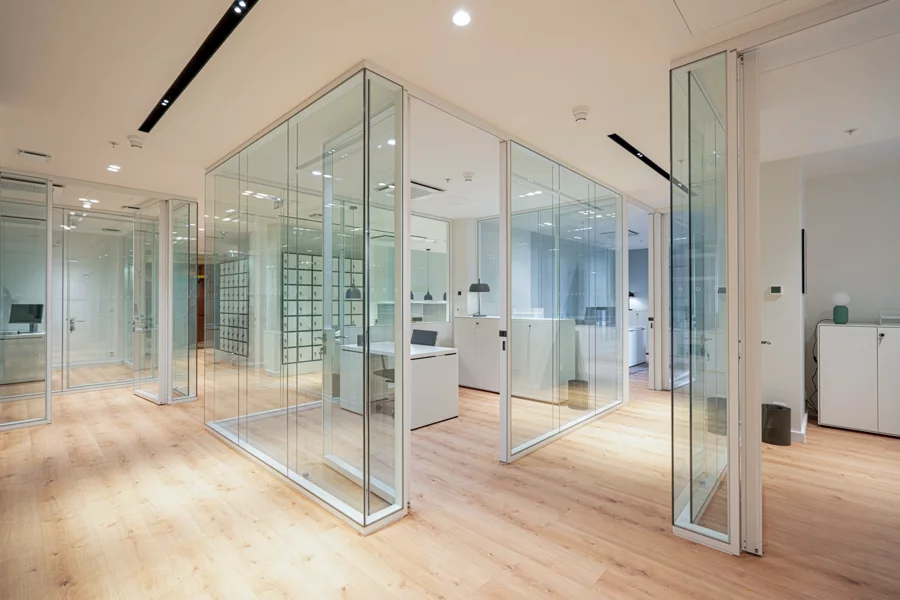
Private offices, however, remain freely priced, with significant differences depending on the prestige of the address and the level of services included. As an example, expect €1,500 per month (charges included) for a 9 m² private office at Puzzle Business Center in the Jardin Exotique district, and €2,800 per month for an office at MCBC III overlooking Port Hercule. “It will always be cheaper than renting a private office in Monaco,” notes Yann Bertrand. Especially since this fixed cost includes air conditioning, electricity, cleaning, and other amenities such as a kitchenette, printer access, and meeting room bookings. Some centers also organize business lunches, events, conferences, networking evenings, or offer mail opening and scanning services. Large private offices are also available — up to 25 m² at MCBC and up to 80–90 m² at One Business Office thanks to removable partitions.
Lower costs and a community spirit
Business centers also offer a valued sense of community. “People like coming for the network, to get out of the house, and to avoid the isolation some entrepreneurs feel,” says Mélanie Diez, director of One Business Office. These communities can even foster synergies. “You’re surrounded by companies that could become clients or partners,” adds Yann Bertrand. “I’ve had clients who didn’t know each other and weren’t even in the same industry, and they eventually launched a company together,” illustrates Mélanie Palacio-Crozet, founder of Puzzle Business Center.
Who are the clients of business centers?
Entrepreneurs choosing to register their business and/or work from a business center in Monaco come from highly diverse backgrounds. Clients include residents (Monégasque nationals, spouses of nationals, and foreign residents) as well as non-residents, particularly French and Italian. The range of sectors is just as varied: family offices, communications firms, yachting companies, building contractors, or even fitness coaches doing their accounting at the center. However, medical professions and lawyers cannot register their practices there. Clients are no longer limited to newly formed companies in need of temporary or ancillary solutions, and according to Yann Bertrand, “being in a business center no longer carries the limiting image it once had.”
High occupancy, lower physical attendance
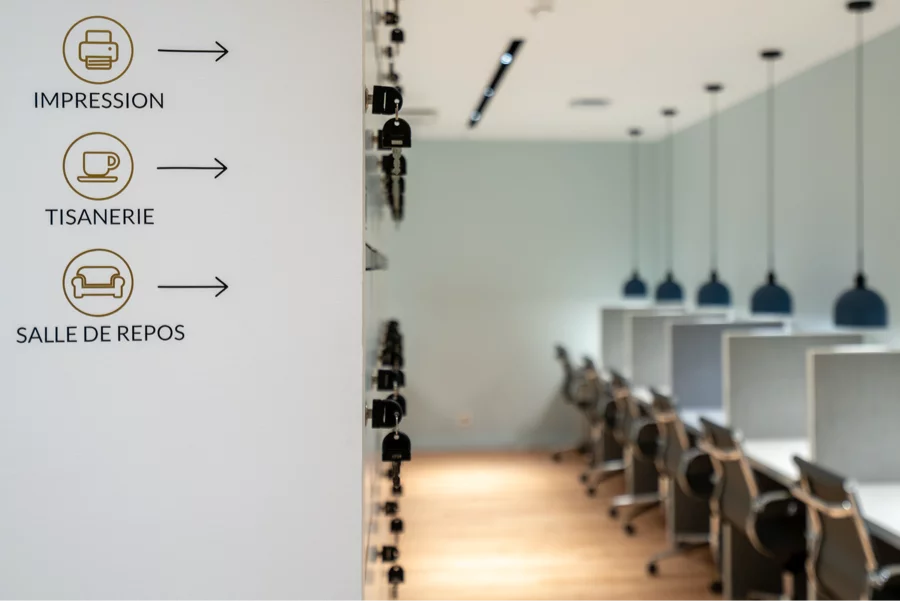
The arrival of the global giant Regus in 2008 — now based on Boulevard d’Italie — highlights the attractiveness of Monaco’s market. With more than 3,000 locations in 120 countries, the group is one of the world leaders in flexible workspace. Today, Monaco has 34 business centers, nearly all operating at full capacity. Every district is covered except, unsurprisingly, Monaco-Ville. Because their success relies primarily on registered business addresses, occupancy rates are high (between 80% and 90%), while actual physical presence remains much lower (around 30%). For several years, business centers have been considered an overrepresented activity, and new openings are therefore restricted to Monégasque nationals.
A market approaching saturation ?
“Competition is a good thing, especially since we all have our specific strengths. Some host many events, others are more discreet; some are open 24/7, others close evenings and weekends; some have a very young clientele, others less so… I think there’s something for everyone,” says Mélanie Palacio-Crozet, before adding a note of caution: “If the sector grew this much, it’s because there was demand — but at some point, there may be too many.” A warning echoed by Yann Bertrand: “It’s becoming increasingly competitive, and I think at some point, limits will need to be set,” he says.

