
For years, Monaco’s property market has been a battleground. With more than 160 real estate agencies, an overrepresentation of property traders, and a multitude of unauthorized intermediaries, fierce —and at times unfair— competition has taken hold. To professionalize and regulate this central pillar of Monaco’s economy, two new legislative texts have emerged, introducing key measures: mandatory effective residence in Monaco, an end to the use of nominees, compulsory written mandates, a professional license, and continuing education. Here is what to remember.
Everyone wants a piece of the pie… For years, the Monaco real-estate sector has been the scene of ruthless competition. In this highly lucrative field, there are more than 160 agencies, a disproportionately high number of property traders, as well as actors operating outside any legal framework. Among them: concierge companies, multi-family offices, business introducers, and even players based outside Monaco. All of these free agents collect substantial fees despite lacking an official license and, at times, even basic overhead obligations. “The exceptional value of Monaco’s real estate inevitably attracts individuals tempted to cash in on this enthusiasm without the required authorizations or guarantees of integrity and professionalism,” summarizes Nicolas Croesi, National Council member and real estate broker. For industry professionals, patience has run out: they argue it is urgent to professionalize and regulate a market that has become too competitive, too opaque, and too amateurish.
Lawmakers Take Action
This long-standing concern—voiced especially by the Monaco Real Estate Chamber—has finally reached the upper levels of government. After years of inertia, lawmakers have decided to put an end to the free-for-all. The first step came in 2024: a law was introduced to regulate the activity of property traders, whose numbers had become completely excessive in Monaco (1). A second step was the revocation of several multi-family offices operating in the Principality. The reason? Some of them were carrying out real-estate transactions, pocketing fees while bypassing traditional agencies. A third and undoubtedly most significant step is now underway: the foundational legal framework governing real-estate professionals in Monaco (2), dating back to 2002, is set for a full overhaul. Two legislative texts are currently moving forward: a draft law on real-estate activities—already approved by elected officials—and a complementary government bill nearing completion.
An End to Amateurism?
According to the National Council, the aim of these legislative reforms is clear: to eliminate amateurism and unofficial actors. Given the extraordinary transaction values in Monaco, the high-end profile of clients, and rising compliance requirements, approximations can no longer have a place in the sector. “The growing complexity of transactions, the increasingly intricate legal and financial structures, and the demands for transparency and compliance call for a reinforced level of professionalism,” states the explanatory memorandum of the draft law. Expertise in real-estate law, co-property regulations, and contract law must now be considered essential standards for any professional in the field.
Mandatory Effective Residence in Monaco
What does the new text foresee? First: obtaining administrative authorization to work in real estate in Monaco will require meeting several conditions. Chief among them: one must have an effective residence in the Principality. “This requirement aims to strengthen the local presence of real-estate professionals. It ensures that economic actors involved in the sector maintain a real and stable presence in Monaco, which is essential for proper oversight, and for maintaining proximity with clients and local institutions,” the text explains.
25% Ownership in the Company
The text also states that agency managers must hold at least 25% of the company’s share capital. “The goal is to reinforce the accountability of managers by tying their role to a real economic interest in the company, ensuring they are not merely detached administrators,” the proposal notes. Given the sector’s exposure to money-laundering risks, lawmakers deemed it essential that “managers be personally and financially involved in the structure they oversee.”
Mandatory Written Mandate
Surprisingly, in Monaco, written mandates are not mandatory—neither for sales nor rentals. The draft law aims to correct this anomaly by making written mandates compulsory, aligning Monaco with France and many other countries. This document will clearly define the contractual relationship and guarantee that only the authorized agent may claim a commission. “This measure ensures that compensation from a real-estate transaction is collected exclusively by duly authorized professionals established in Monaco, subject to training, insurance, transparency, and administrative oversight,” the text states. It contributes to cleaning up the sector and protecting buyers by preventing illegal remuneration practices or services offered by unqualified persons, thus avoiding unfair competition.
A Professional License and Compulsory Training
Another small revolution for Monaco’s real-estate sector: if adopted, the law will require professionals to hold a license card. This will help clients easily identify legitimate industry players. Initially set for renewal every three years, the term has been extended to five years by elected officials. Issued by the Administration, the license card will at minimum specify the holder’s identity, the commercial name of the establishment, the company’s corporate name (if applicable), and the authorized activities. But the novelty doesn’t stop there: agents will also be required to complete professional training. Newcomers—such as junior negotiators starting in Monaco agencies—must do so in their first year, unless exceptions apply. Experienced professionals will have up to five years to comply.
Regulating Advertising
To curb abuses and protect authorized professionals, the text also introduces rules on advertising. Specifically, it will be prohibited to advertise real-estate sales or rentals for commercial purposes unless one is a licensed professional. Private owners may still advertise their own properties, and individuals may share listings non-commercially (for example, reposting a listing online). Naturally, authorized agencies may advertise properties with their clients’ consent.
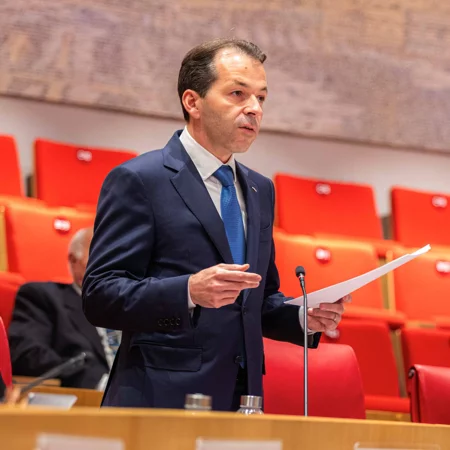
“This text aims to protect authorized professionals against outside appetites, unfair competition, and certain parasites”
For elected official Nicolas Croesi, this reform is indispensable. “Real-estate agents are not and must not be mere door-openers,” he says. “They are often the first—if not one of the first—contacts for people arriving in Monaco. This affects our attractiveness, our image, and our competitiveness.” Monaco’s market demands absolute rigor. “Such a market inevitably attracts all kinds of actors—more or less serious, more or less official—too often less than more. This law aims to protect duly authorized professionals, who are already numerous, against external appetites, unfair competition, and certain parasitic behaviors.”

“Monegasques will be able to enter the sector at lower cost”
Since the market is considered saturated, only Monegasque nationals are currently allowed to open a real-estate agency in the Principality. For nationals wishing to enter the field, the draft law introduces new measures. While an agency cannot be registered at the private residence of the owner or managers, it may be set up in a business center—though only for a maximum of two years from the time administrative authorization is granted. After this period, a dedicated office or commercial premises becomes mandatory. “This will allow Monegasques to enter the sector more easily—highly competitive though it is—at lower cost. It is a concrete measure from the National Council supporting entrepreneurship, which I applaud,” says National Council member Roland Mouflard.

“I often encounter a lack of competence”
Fabrice Notari, National Council member and architect, welcomes the new law aimed at better regulating Monaco’s real-estate sector. He emphasizes the importance of training: “In my work as an architect, I often come across a lack of competence. Some people do not know how to read plans or claim that entire walls can be removed to create large open volumes. Issues arise afterward because clients were not properly advised on the many rules in Monaco—whether regarding construction permits, thermal or acoustic standards, or strict administrative procedures. Buyers often ignore these essential constraints at the time of acquisition. This is why I want to stress the importance of training.”
(1) Law No. 1.252 of 12 July 2002 on the conditions governing real-estate operations and business asset transactions
(2) Law No. 1.560 of 2 July 2024 regulating the activity of property traders

