AVANT-GARDE/Since the 1960s, Monaco’s offshore extension has inspired many avant-garde architects. Including with some totally over-the-top projects….
Throughout his career in the Public Works department, José Badia saw a heap of sea urbanisation projects parade by – from the more credible to the more outlandish. The former minister has seen it all. From ideas of floating islands off Monaco to doubling Cap Martin, in the Sporting d’été extension… “Studies showed that the only place where a containment could be created, from the technical point of view, was the Tombant des Spélugues, below the Loews Hotel. So it was envisaged to create a small plunging plateau of -10 to -15 m. Half a dozen projects were submitted by public authorities or private players. For example in the 90s, Bouygues, the Solidere operator in Beirut, had already initiated a project for a protective sea wall.” For Fontvieille II, there was the same abundance. There were many public works reviews. François Spoerry, the famous architect of riparian cities and marinas including that of Port Grimaud, planned a Fontvieille extension. What was the snag? “Such a marina required building on bedrock with caissons at a depth of 70 or 80 m, with an offshore technique. The body of water had to be protected with a counter jetty and an oscillating wall of water,” explains José Badia. The project failed due to the lack of developers able to ensure the profitability of the investment… “Monaco had to pay for the protective structure, it was too costly,” the former minister says.
2005 study
Before launching the international tenders for sea urbanisation, in the early 2000s in a study for Prince Rainier, the former recorded the opportunities presented in Monaco. “It was up to the prince to set the course for the future extension. It was his baby, his territory,” explains José Badia. In this “catalogue of slightly crazy ideas” were the filling in Port Hercule (with reconstruction of a port further away), realisation of a” Monaco in a mirror” (by building a Monaco opposite the existing territory), artificial land with Rock shaped islands etc.
Futuristic projects
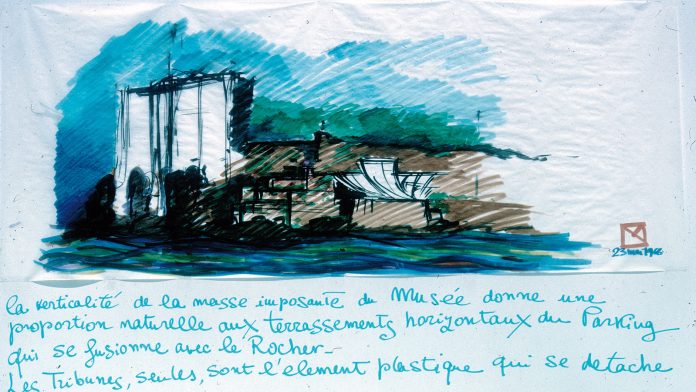
Historically, the extension of Monaco has inspired many avant-garde architects. Manfredi Nicoletti’s The Satellite Town comes to mind in particular. In 1966, the Italian imagined a Fontvieille reclaimed from the sea, as a district of artificial hills, “open to the sea like an amphitheatre, reminiscent of the appearance of Marina-Baie des Anges,” states the book Monacopolis, taken from the New National Museum exhibition. Although very quickly abandoned (see p. XX), the project left its mark in people’s minds with a Fontvieille shopping centre designed like an arcade in the form of a springboard over the sea…
As for Yona Friedman, in 1960 she even designed a Monegasque Venice – a true suspended and transparent bridge-city… The French architect of Hungarian origin transposed this concept to London and Paris. In Monaco, her idea was to build a four hundred metre long six storey building, fifteen metres above the old jetties… But it was undoubtedly the launch of the Larvotto urbanisation project, in 2006, that brought together the most projects issuing from “Nobels” for architecture. What with Norman Foster, Franck Gerhy and Daniel Libeskind, seven Pritzker prize-winners worked on the Portier project, finally abandoned in 2008 due to the financial crisis.
(R)EVOLUTION/
Floating houses in Dubai


