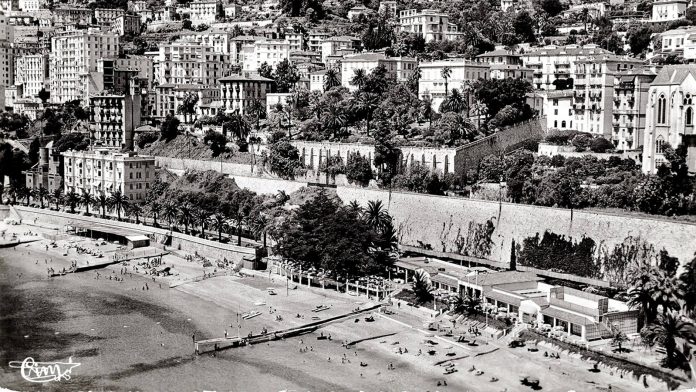
HISTORY/Monaco-sur-mer is nothing new. Since the early 20th century, Monaco has been encroaching on the sea to push on its walls. From Larvotto to Fontvieille.
From 1861, Monegasque territory was reduced to nothing. Menton and Roquebrune voted to be annexed to France and Monaco comprised only 150 hectares. For this reason, from the early 20th century, the Principality began to look to its maritime borders to expand. Fills along the Larvotto coast to the east and in Fontvieille to the west enabled it to reclaim some hectares from the sea. And that was just the beginning of the rush on the sea.
After the Second World War, Monaco moved to the second project. With an initial 35 000 m2 island at Portier completed in 1961 (to house the Grimaldi Forum much later) and a second one, built by Société des Bains de Mer under a state concession. “On this 54 000 m2 expropriation, the new Sporting d’été was to be built in the 70s. But this addition caused some problems with France, which accused Monaco of encroaching on her territory,” says Frédéric Laurent, author of the book “Le prince sur son Rocher”. “At that time, any excuse was good for bringing Monaco to heel. Since the Franco-Monegasque Agreement of 1918, Monaco was a de facto protectorate in the minds of the French,” the journalist adds.
Builder prince
Under the reign of Rainier III, aka “the builder prince”, the least m2 was optimised by developing the existing land as best as possible. “The railway line route, built in 1868, cut through the entire length of Monegasque territory. It isolated and ‘sterilised’the Larvotto district, bordering on the seafront. So a new route was devised. The railway was deported further north in a 3 km tunnel opened on 13 December 1964. Monte-Carlo station, required by SBM a century before to ease gamblers’access to the gaming rooms to the maximum, was (even) scrapped, freeing up new land,” notes Frédéric Laurent.
If anyone benefited from that freeing up of land in Larvotto, it was Gildo Pastor. Having acquired most of it from 1939, the heir of JB Pastor, who had already built the Louis II stadium in Fontvieille, was to build almost all of the famous low-rises of luxury residential seafront buildings in the 70s, which would establish the family fortune. His project was initiated in the 50s. “His idea was to cover the ballast and build a new district over it,” explains the journalist. “He proposed his idea to Louis II. “It’s a fine project but I’m too old,” was the reply. “Be patient – you’ll do it with my successor.””
That is indeed what happened. But not without debate. As part of the review of the Larvotto and Portier decommissioning law in 1971, the then national councillors certainly welcomed “as a major contribution to Monaco’s economy, the property development of a district destined to become the focal point of our city and be a powerful new stimulus to all of the country’s activities.” But some people swallowed ‘a bitter pill’, feeling forced to break the deadlock of a property programme frozen for decades, due particularly to legal disputes with Gildo Pastor. “It’s heartbreak, but for the district to get going again and for business to reign in this seaside district, for the hotels to be built there to come to life and a new population and new customers to come to Monaco, I believe that as Paris was well worth a mass, unfortunately the extension of this district deserves that we swallow this pill,” said the emblematic Jean-Charles Rey, who had also advocated expropriating the district in 1954 so that the state would own it…

Fontvieille breakwater, world champion for depth
In parallel, Monaco also increased its territory to the west. Fontvieille, the result of a 220 000 m2 complex containment, represents renewal. It saw gigantic works to build the island, as part of a 1965 concession granted to the Monegasque company SADIM, formed by a Franco-Italian group. “It wasn’t easy. First a one kilometre long breakwater had to be built. This gigantic work rests on a truncated pyramid shaped platform with a 90 m wide base, 47 m from the water surface. It is in fact a huge embankment with a volume in excess of one million m3, on which are stacked forty concrete caissons filled with sand, as tall and wide as a 6 storey building. Above is a reinforced concrete esplanade fitted with a breakwater wall,” sums up Roger Louis Bianchini in “Monaco, une affaire qui tourne”.
Former government minister José Badia remembers this exciting time for Monaco, where “everything had to be done. From earthquake resistance rules to urban plans.” In the planning department headed by Secretary General Bernard Fautrier, the engineer remembers the technical difficulties of this site, particularly to densify the island. “Dynamic compaction consisted of having a large puck fall from a crane boom. On each release (which made a lot of noise), the island sank one metre! That allowed the final level to be seen. Only small buildings could be constructed on the compacted ground. Piles were required for the higher buildings.” There was another difficulty: “Belts had to be built to prevent the water from entering the basements of the future buildings with the changes of tides.”
Monaco won fame above all with its new offshore breakwater: “Erected at a depth of 40 m, at that time it was the world champion for depth. Since then, its record has been beaten by the Sines breakwater in Portugal,” notes the former minister. He was amused by the rumours the construction site prompted at the time: “There were rumours that it was being used as a huge refuse bin! That was not true. The fills (stones and pebbles) came from Fos-sur-mer…”
Financial gamble
Beyond the technical aspect, Fontvieille became a financial gamble for the Monegasque state. In 1965, the concession for the containment provided that SADIM finance construction of the district, with in return the ownership of 2.32 million m3 of buildings. With the state recovering 150 000 m2 of land. The tide turned in 1971. “The building permit filed by SADIM displeased Prince Rainier. On the Grande Motte or Baie des Anges Marina model, it provided for ‘melon slices’at great heights with daring architecture,” says José Badia. And the palace’s rage is understandable. The project rose up 91 metres, meaning 30 metres above the Rock! Deprived of authorisation, SADIM then proposed that the state buy back the land for 400 million francs. That caused panic – right in the pre-election period – among a part of the population who were convinced the state would sell gold from the reserve fund to finance the SADIM buy-back. “Our political opponents, particularly Charles Soccal and Jean-Eugène Lorenzi, had sent the Monegasques a leaflet explaining that Monaco would be ruined if the state bought back the island! And thus that the Monegasques would soon have to pay taxes…,” former member of parliament Jean-Joseph Pastor recalls. On 27 June 1973, the national council ended up voting with a large majority to buy back the land reclaimed from the sea, a genuine land reserve intended to house industrial platforms, a school, social buildings for the Monegasques and luxury buildings, new oil for Monaco. On the funding side, “it was national council member Jean-Louis Campora who devised an acceptable system. His idea was to buy back one part by paying SADIM cash and have the other bought by a private company. In the end, the Canadians came forward (a group controlled by Mobil Oil Canada). Before the state bought back their parts. And at a higher figure, of course, “says the former national council doyen. Under pressure from the assembly, the government also agreed to reduce its bank lending facility from 90 to 50 million francs, and the loan term from 15 to 5 years.
Neo-Provencal village
So the district’s appearance was transformed. From the much denigrated famous ‘melon slices’, it changed to a neo-Provencal style village. Fontvieille also houses one of the first urban stadiums. It was designed by the Monegasque architect Rainier Boisson, then aged 34, a partner with Henry Pottier, Philippe Godin, Jacques Rechsteiner and Joseph Iori. “The concept, developed as part of my studies, was to create a living stadium. In contrast with the Parc des Princes landmark stadium, for example. Given the smallness of the territory and the intertwining of the city, it was interesting to have a stadium accommodating shops and 12 000 m2 of offices in addition to the sports complex,” Rainier Boisson explains, adding the financial advantage, “All bodies contributed to the stadium operating costs, which is not negligible.” Especially as the site, initially estimated at 430 million francs, was to finally verge on 530 million francs in 1984…
In hindsight, for José Badia, “Fontvieille is undoubtedly an intelligent urban development project.” And the proof? “Fontvieille was such a rapid success that the Fontvieille II project appeared straight afterwards… “For the former Minister for Public Works, Monaco largely won its financial gamble with sea urbanisation. “The government and national council at that time invested almost all the constitutional reserve funds. But Prince Rainier did not play dice… Monaco has always valiantly supported profitable investments, such as the port complex which cost 1 billion euro. Other countries could not have afforded this type of mammoth site!”
STATE HOUSING/

