vendredi 1 mai 2026
plus
    AccueilInfosImmobilierCrazy, crazy, crazy projects…

    Crazy, crazy, crazy projects…

    -

    AVANT-GARDE/Since the 1960s, Monaco’s offshore extension has inspired many avant-garde architects. Including with some totally over-the-top projects….

    Throughout his career in the Public Works department, José Badia saw a heap of sea urbanisation projects parade by – from the more credible to the more outlandish. The former minister has seen it all. From ideas of floating islands off Monaco to doubling Cap Martin, in the Sporting d’été extension… “Studies showed that the only place where a containment could be created, from the technical point of view, was the Tombant des Spélugues, below the Loews Hotel. So it was envisaged to create a small plunging plateau of -10 to -15 m. Half a dozen projects were submitted by public authorities or private players. For example in the 90s, Bouygues, the Solidere operator in Beirut, had already initiated a project for a protective sea wall.” For Fontvieille II, there was the same abundance. There were many public works reviews. François Spoerry, the famous architect of riparian cities and marinas including that of Port Grimaud, planned a Fontvieille extension. What was the snag? “Such a marina required building on bedrock with caissons at a depth of 70 or 80 m, with an offshore technique. The body of water had to be protected with a counter jetty and an oscillating wall of water,” explains José Badia. The project failed due to the lack of developers able to ensure the profitability of the investment… “Monaco had to pay for the protective structure, it was too costly,” the former minister says.

    2005 study

    Before launching the international tenders for sea urbanisation, in the early 2000s in a study for Prince Rainier, the former recorded the opportunities presented in Monaco. “It was up to the prince to set the course for the future extension. It was his baby, his territory,” explains José Badia. In this “catalogue of slightly crazy ideas” were the filling in Port Hercule (with reconstruction of a port further away), realisation of a” Monaco in a mirror” (by building a Monaco opposite the existing territory), artificial land with Rock shaped islands etc.

    Futuristic projects

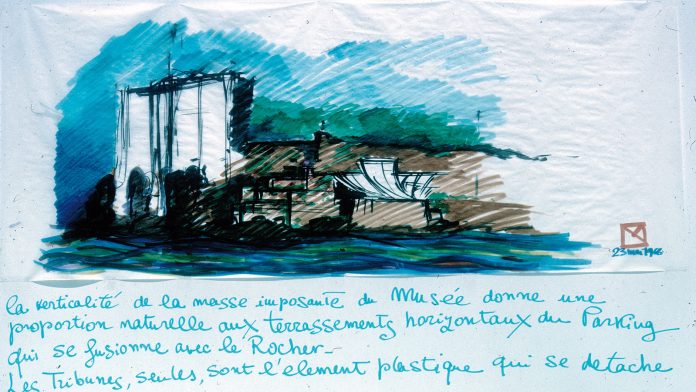
    Historically, the extension of Monaco has inspired many avant-garde architects. Manfredi Nicoletti’s The Satellite Town comes to mind in particular. In 1966, the Italian imagined a Fontvieille reclaimed from the sea, as a district of artificial hills, “open to the sea like an amphitheatre, reminiscent of the appearance of Marina-Baie des Anges,” states the book Monacopolis, taken from the New National Museum exhibition. Although very quickly abandoned (see p. XX), the project left its mark in people’s minds with a Fontvieille shopping centre designed like an arcade in the form of a springboard over the sea…

    As for Yona Friedman, in 1960 she even designed a Monegasque Venice – a true suspended and transparent bridge-city… The French architect of Hungarian origin transposed this concept to London and Paris. In Monaco, her idea was to build a four hundred metre long six storey building, fifteen metres above the old jetties… But it was undoubtedly the launch of the Larvotto urbanisation project, in 2006, that brought together the most projects issuing from “Nobels” for architecture. What with Norman Foster, Franck Gerhy and Daniel Libeskind, seven Pritzker prize-winners worked on the Portier project, finally abandoned in 2008 due to the financial crisis.


    (R)EVOLUTION/

    Floating houses in Dubai

    maisons-flottantes-dubai-the-floating-seahorse-signature-edition-04

    The first essay on maritime engineering dates from antiquity. We owe these precepts on the methods of construction of breakwaters, jetties and quays to Marcus Vitruius Pollio, alias Vitruve, who lived in the first century BC. In Europe, the Netherlands is the biggest fan of polders, or land artificially reclaimed from the sea. Moreover, in Holland, consulting and architecture firms now specialise in blue architecture and the construction of floating buildings. And the concept has been emulated. In March 2015, at the international boat show in Dubai, the property developer Kleindienst caused a storm when they presented their programme for the construction of luxury floating houses. These “Seahorses” – villas on three levels which are partially submerged, located 4 km from the coast and near the six islands forming the “Heart of Europe” (part of Dubai’s famous “The World”) – recreate an artificial coral reef located beneath the house. According to the developer, around sixty properties have been sold, at a price of 2.8 million dollars (2.4 million euro). _M.R.

    -

    Les dernières news

    L’Observateur de Monaco

    Créé en 2005, L’Observateur de Monaco s’est progressivement imposé comme un rendez-vous mensuel d’information et d’analyse consacré à la vie de...

    Plongée nostalgique dans le Monaco des années 50 à 70

    C’est une immersion dans le Monaco d’hier. À travers un document baptisé Florilège d’actualités monégasques filmées par TMC, la plateforme de l’Institut audiovisuel de Monaco a exhumé des mini-reportages tournés entre 1956 et 1974 par Télé Monte-Carlo.

    Sécurité, projets pour le Devens, salles de prières, relations avec Monaco… Les propositions des candidats aux municipales de Beausoleil

    De la sécurité au réaménagement du Devens, en passant par la question des lieux de prière, les candidats aux municipales de Beausoleil déclinent leurs priorités et leurs propositions.

    La Sélection

    Jeunes diplômés à Monaco : voici les secteurs qui recrutent

    Créée en 2010, la Commission d’insertion des diplômés (CID) aide la jeunesse de la Principauté — et désormais celle des communes limitrophes — à trouver un stage, une alternance, ou un premier emploi à Monaco. Comment ces jeunes lycéens et étudiants sont-ils accompagnés dans le grand bain de la vie active ? Quels sont les secteurs d’activité qui recrutent et ceux qui embauchent peu en Principauté ? Et quel est l’intérêt des entreprises monégasques à collaborer avec cette commission ? L’Obs’ vous dit tout.

    Activités immobilières à Monaco : le grand ménage législatif

    Avec plus de 160 agences immobilières, une surreprésentation de marchands de biens, et une multitude d’intermédiaires non autorisés, une concurrence féroce et parfois déloyale se joue. Pour professionnaliser et encadrer ce secteur central de l’économie monégasque, deux textes de loi ont récemment émergé avec des mesures clés : obligation d’une résidence effective à Monaco, fin des prête-noms, mandat écrit obligatoire, ou encore carte professionnelle et formation continue. Voici ce qu’il faut retenir.

    Monaco veut défendre son image à l’international face aux critiques

    Face à des articles de presse considérés comme « dévalorisants », le gouvernement monégasque et le Conseil national souhaitent mettre en place une communication plus proactive à l’international pour défendre l’image de la Principauté.