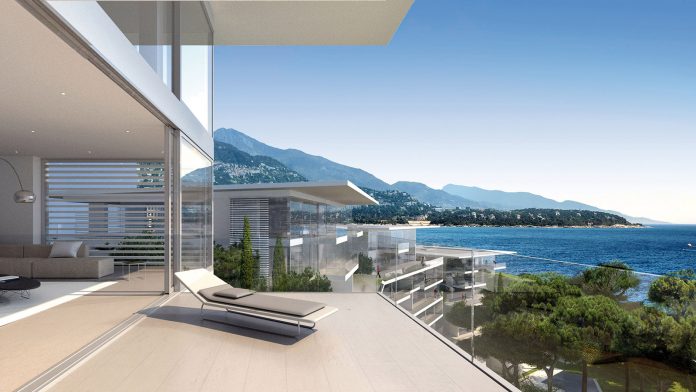
URBANISATION/Monaco is reclaiming land from the sea once again. The 6 hectare extension to Monegasque territory will be created at Anse du Portier. The focus is on a 2 billion euro construction site with completion in 2025.
A few fathoms from Portier is a platform spawning ships moored offshore. A sign of foundation stones of the sea urbanisation site to open this autumn with completion in 2025. For the time being, the operator – the Anse du Portier/Bouygues Travaux Publics group – is merely performing geotechnical surveys to calculate the thickness of the marine sediment it will have to remove before concretely starting the dredging. “The preparatory work will start in September. It consists of moving the protected species, cleaning caulerpa taxifolia seaweed and diverting the networks (particularly for rainwater discharge),” explains Jean-Luc Nguyen, director of the sea urbanisation mission. Also this autumn, Larvotto residents will witness the installation of a noise barrier along the Promenade des Champions. But do not expect to see chains of lorries moving the concrete caissons required to build the reclaimed land straight away. Since the site is primarily maritime (see the schedule in the box), land disturbances will be limited in the first instance – the lorries will only come into Monaco from 2020.

Challenging project
For the Anse du Portier urbanisation, a gigantic site is being prepared. Not necessarily for the scale of the project that will colonise 6 hectares of the Mediterranean Sea. That is far less than the 22 hectares reclaimed in Fontvieille in the 70s, or even the 15 hectares of the aborted Larvotto project, abandoned in late 2008 due to the financial crisis. But to create this new eco-district – bringing together 60 000 m2 of luxury housing and 3000 m2 of shops, public amenities, a Grimaldi Forum extension of around 3500 m2, a public car-park and a thirty-ring marina – the operators need to struggle with numerous constraints. The first of which being, “The reclaimed land needs to withstand events such as sea swell or earthquakes. The chosen technical solution is a fill protected by a caisson wall, as in Beirut for example,” says Jean-Luc Nguyen. He then adds, “In order for the caisson belt to be very stable, we must first remove the silt on the seabed and replace it with crushed fill. Each caisson resting on this fill will weigh around 10 000 tonnes when filled with ballast!” Stability is obviously synonymous with durability in this type of maritime construction. Dubai has experienced this at its expense. The grandiose “The World” project launched in 2003 included construction of 300 islands reproducing a world map. At the beginning of the work, the building of this structure required the import of around 300 million tonnes of sand and 34 million tonnes of rocks. The work was put on stand-by because of the financial crisis from 2007 and 2009, and the islands that had already been built began to drift, move closer and even be submerged by the waves. According to observers, due to lack of maintenance The World began to sink slowly into the sea, submerging the trifling sum of several billion euro. Other problems can arise. “Dubai had built two palm-shaped islands. The fills were affected by subsidence. There was a water stagnation and odour issue as the infilling had not been sufficiently contained. The issue has since been resolved with the installation of ducts,” one observer notes. Could such a scenario happen in Monaco? According to Jean-Luc Nguyen this is impossible. “Fill subsidence or water circulation issues encountered with some projects should not occur in Monaco as they have been well examined. Likewise, the rise in sea level due to global warming (that could reach 80 cm) has been anticipated. The coastal promenade will be located at over 6 m and the ground more than 8 m above water level. It is a fairly high project,” says Jean-Luc Nguyen, also recalling that the project rules out basements built below sea level. For comparison, Nice airport, where 200 hectares were reclaimed from the sea, is 3 m from the water.
“Shoehorn needed!”
Another major constraint for the builders, “The site is located between two natural reserves. It was due to environmental concerns in particular that the previous project was abandoned and that further extension in this area would be very complicated. The site execution phase will therefore be very tight,” Jean-Luc Nguyen points out. “We really need a shoehorn!” one observer adds. This calls for special measures. Thus, technically, the operations will be performed either with a watertight ecological dumpster or a ‘suction dredger’to prevent any spread of turbidity. Fill material washed in advance, installation of a turbidity curtain, removal of polluted sediment, and real-time calculation of water quality during all work phases. Operations will be moved or stopped immediately should there be malfunctions. The real risk can only come from a site accident. “Zero risk does not exist but the main hazards lie above all in the construction phase. Otherwise, most matters have been taken into account upstream,” promises Jean-Luc Nguyen.
IN FIGURES/
• 110 000 tonnes of rock fill placed on the existing Portier sea wall.
• 620 000 m3 of de-silting and dredging of sediment in place (trenches).
• 2.87 million tonnes of 20/180 quarry materials brought by ship from Toulon to construct the fills supporting the caissons, the caissons ballast and the technical fills behind the caissons.
• 48 000 tonnes of rock fill placed to protect the new underwater fill.
• 18 caissons prefabricated in Fos-sur-Mer: 86 000 m3 of reinforced concrete to include 18 000 tonnes of framework comprising 3 500 tonnes of stainless steel.
• 600 000 m3 of dredged sand to build the new reclaimed land.
• 1.54 million m3 of fills treated with maritime or land vibro-compaction.
• 360 000 m3 of ground reinforcement
• 17 000 m3 of civil engineering concrete applied in the Monaco site.
• 100 people for four and a half years, to make up the management, engineering and supervision teams of the Monaco site.
• 50 people for 20 months, to perform civil engineering work in Monaco.
SCHEDULE/
• Spring 2013: international call for applications aimed at selecting an operator to take care of the new sea urbanisation project
• July 2015: signing of the concession agreement for the Anse du Portier sea urbanisation project
• 28 June 2016: voting on the bill with the purpose of decommissioning the public sector facilities located on the Anse du Portier site right-of-way, to allow full completion of the project.
• 4th quarter 2016: work to begin in Monaco (start of conservation measures for protected species and preparatory work).
• 2nd half of 2019: completion of the protection belt and start of work on the Installations phase (public and private car-parks, technical areas, underground ways etc.)
• 1st half of 2020: completion of the maritime infrastructure.
• 2nd half of 2020: beginning of the superstructures.
• 2022: Finishings/supply of the first buildings.
• 2024: Supply of the marina and the Grimaldi Forum extension.
• 2025: Finishings and supply of the overall project.

