In terms of real estate, the three most expensive cities in France are located on the French Riviera, according to a recent study by the National Federation of Real Estate (FNAIM). Housing is generally more expensive in coastal resort towns compared to other areas, driven by heightened post-COVID demand and a higher quality housing stock, especially in the South. However, climate risks, previously overlooked, could soon start dampening this enthusiasm.
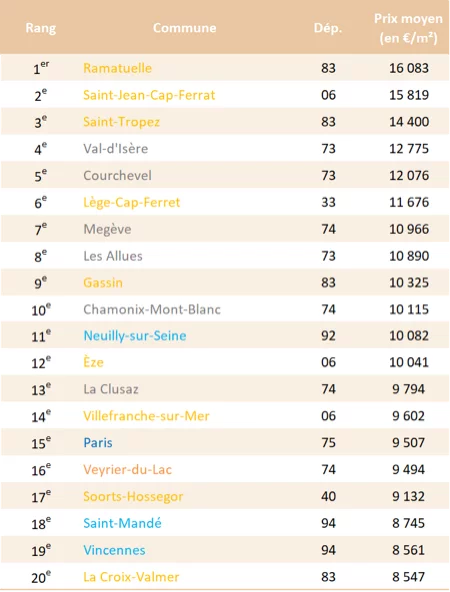
In 2024, the top three most expensive cities in France are all seaside resorts on the Côte d’Azur: Ramatuelle (average price of €16,083 per m²), Saint-Jean-Cap-Ferrat (€15,819 per m²), and Saint-Tropez (€14,400 per m²). This ranking, published by FNAIM in July, places all three in the coveted top positions.
In the broader Top 20 list, another town in Var, Gassin, appears alongside Eze and Villefranche-sur-Mer in the Alpes-Maritimes, ranking 12th and 14th respectively. Surprisingly, Paris only ranks 15th based on average prices, although certain areas like Quai des Orfèvres and Avenue Montaigne still exceed records, going beyond €20,000 per m².
Post-Covid price surge
The study indicates that property prices in resort towns are, on average, twice as high as those in the rest of the country—€4,514 per m² compared to €2,933 per m². Over the past decade, prices have risen significantly faster in these coastal areas, especially during the 2020–2023 period, which saw a surge in demand for space and nature prompted by lockdowns.
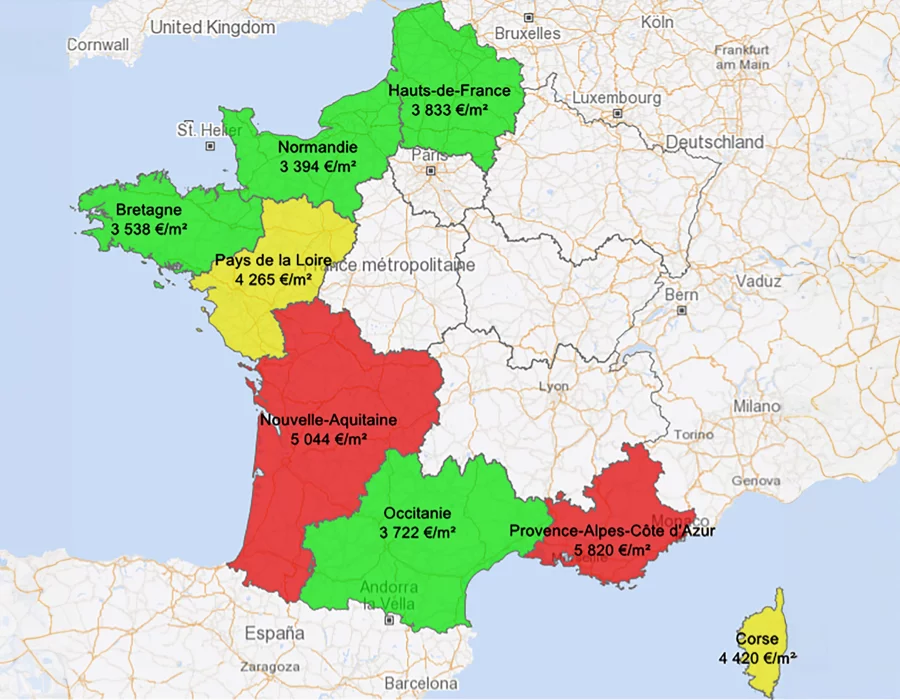
The Provence-Alpes-Côte d’Azur (PACA) region has the highest average prices among seaside resorts, with its 42 towns averaging €5,820 per m². The region’s least expensive towns, all in Var, are Fréjus, Hyères, and Cogolin, with prices hovering around €4,500 per m². Between June 1, 2023, and June 1, 2024, PACA was the only French region where property prices continued to rise, albeit modestly (+0.3%). The sharpest declines were observed in Nouvelle-Aquitaine (-6.3%) and Pays de la Loire (-5.9%).
Another interesting metric highlighted in the study is the volume of transactions in French coastal resort towns. Here, Cannes and Antibes lead the list, followed by Agde (Hérault), Saint-Raphaël, and Fréjus. Cagnes-sur-Mer ranks 9th, and Menton 11th. Notably, Parisians account for 15% of the buyers in these seaside locations.
A market apart
FNAIM also underlines the unique characteristics of the real estate market in resort towns. Firstly, these towns have relatively few permanent residents compared to other areas: four out of five seaside towns have fewer than 5,000 inhabitants. These areas also have a high concentration of second homes (47%, compared to 10% in the rest of the country). In fact, one-third of all French second homes are in one of the 520 coastal resort towns.
The study also points out a higher proportion of retirees in these areas—35%, versus 22% in non-coastal municipalities. The average age of buyers in resort towns is 54.7 years, nearly a decade older than in the rest of France, where it is 45.8 years.
Another takeaway from the study: the proportion of foreign buyers in resort towns is lower than in mainland France, at 6.1% compared to 8.1%. However, among foreign buyers, a large proportion are non-residents, accounting for 47% of the foreign buyers in resort towns, versus 38% in mainland France.
Top 20 : most expensive French cities
Higher quality housing in the south
Overall, the report notes that housing in resort towns is of better quality, especially in terms of energy efficiency, compared to other areas. About 45% of homes in resort towns are rated “A,” “B,” or “C” on the energy performance scale, compared to 35% elsewhere. The proportion of energy-inefficient homes (labeled “F” or “G”) is lower in resort towns (9%) than across the rest of metropolitan France (13%), with the PACA region having the fewest (just 4%, compared to 18% in Brittany, for example). « Overall, southern French resorts have better energy performance ratings than those in the North, » FNAIM notes.
Climate risks begin to dampen buyers’ enthusiasm
Given their geographical location, resort towns are naturally more exposed to climate risks, particularly coastal erosion exacerbated by global warming and human pressures. According to FNAIM, over the past 50 years, 30 km² of land has disappeared due to coastal retreat, with this trend expected to worsen. A total of 213 municipalities are at risk of coastal erosion or flooding, 157 of which are coastal resorts. Only five of these are in PACA, with Brittany being the most affected region, counting 61 at-risk municipalities. Until recently, buyers were largely unconcerned by this risk, as prices in high-risk coastal towns even rose faster than those in unaffected ones from 2014 to 2023. However, this trend has begun to reverse in recent months, likely due to the new requirement to disclose these risks in property listings, which became mandatory on January 1, 2023.
Key Figures
In PACA, the three most expensive towns are :
1.Ramatuelle (83): €16,083/m²
2. Saint-Jean-Cap-Ferrat (06): €15,819/m²
3. Saint-Tropez (83): €14,400/m²
These are also the three most expensive municipalities in France.
The three least expensive towns are:
1. Fréjus (83): €4,357/m²
2. Hyères (83): €4,599/m²
3. Cogolin (83): €4,634/m²
Source: FNAIM Study – Real Estate in Seaside Resorts, July 2024.
(1) According to FNAIM, seaside resorts are defined as « coastal municipalities with at least 15% second homes and that either have a beach or are classified as a tourist destination. » By this definition, mainland France has 520 seaside destinations, 42 of which are in the Provence-Alpes-Côte d’Azur region.

